Pictogram - Picture Cryptogram
- 4.7
- Rating
- 100.00K
- Installs
- Free
- Price
 Analysis by App-foxy
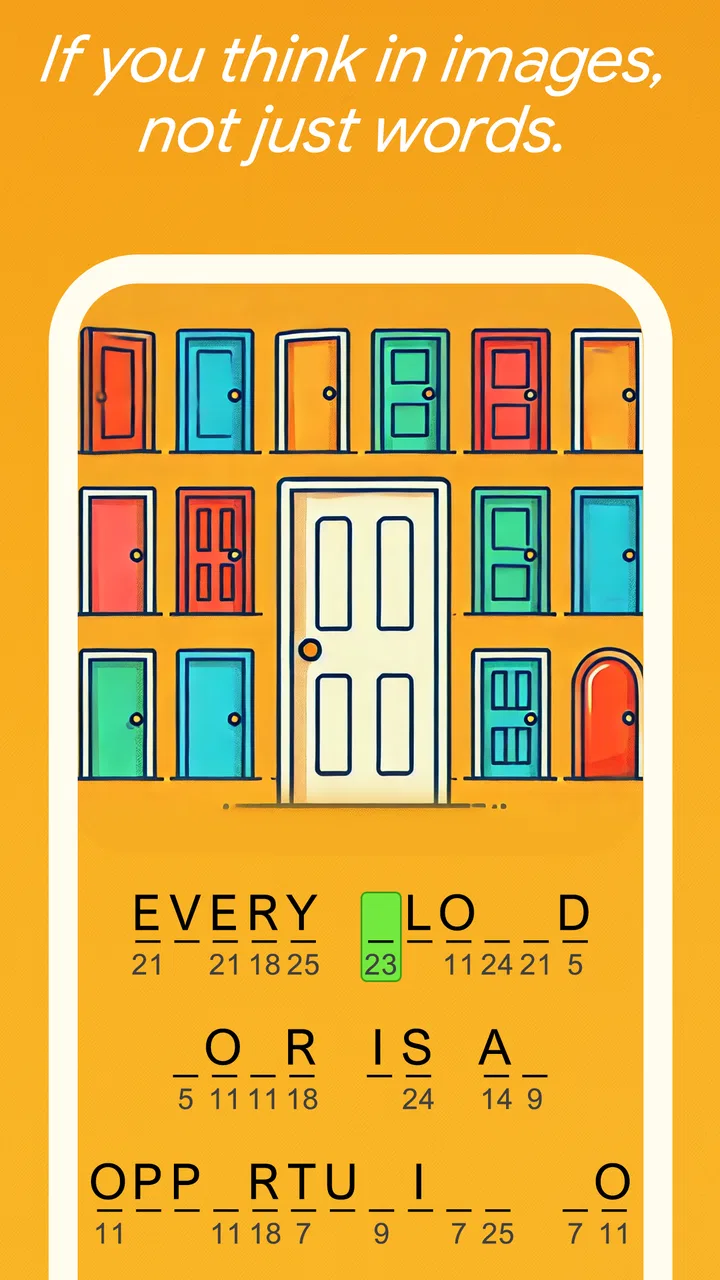
Some word games ask me to build vocabulary, others test spelling, and a few are really about noticing patterns. Pictogram - Picture Cryptogram belongs to that last group. I read a visual clue, think about the phrase or idiom it may represent, and then use the letters to confirm whether my interpretation is right. That simple loop makes it easy to start, but the best moments come when the picture seems obvious and my first answer turns out to be completely wrong.
I found it most appealing as a short-session game rather than a title I would play continuously for hours. It works well when I want a mental break, something to do while waiting, or a light challenge to share with another person. The game is free to download, developed by Joy Vendor, and aimed at Everyone, so it has a broad audience. Its current version is 1.5.14, and it runs on Android 7.1 or later. Those details matter mainly because the game is accessible to people using older devices, rather than being limited to recent phones.
The store listing describes more than a thousand picture riddles and word puzzles, with a focus on decoding idioms and exercising the brain. In practice, the important question is not simply whether there are many puzzles. It is whether the visual clues feel fair, whether the answers are satisfying, and whether the game gives me a reason to continue after an easy opening round. My experience is that this is best understood as a casual picture-based word puzzle for players who enjoy interpreting clues more than competing for speed.
You May Also Like

 Blood Strike: 2.5 Anniversary
Blood Strike’s Loadouts Turn Every Drop Into a Tactical Gamble
A close look at Blood Strike’s custom loadouts: how fast access to signature weapons reshapes its battle royale rhythm, rewards preparation, and narrows the gap between fights.

 Pandora - Music & Podcasts
Pandora’s Music Is Easy to Start, but Harder to Recover
Pandora’s strength is its low-effort path from a seed to a station. Its weak spot is how much confidence it asks you to place in connection, setup, and quiet recovery.

 8 Ball Pool
 Is Built on Rivalries, Rematches, and Routine
A close look at the rivalries, rematches, shared routines, and unanswered safety questions that turn a quick pool match into a persistent mobile community.

 Samsung Music
’s Quiet Strength Is Playing What You Already Own
Its reach comes less from spectacle than from dependable access to a personal library. That simplicity is both the app’s strongest retention engine and its ceiling.

 AccuWeather: Weather Radar
AccuWeather Review: A Quick, Clear Forecast for Everyday Decisions
For everyday plans, the best forecast is the one you can understand quickly. AccuWeather makes rain timing, radar, and local conditions easy to act on, with a few trade-offs.

 Hill Climb Racing
Why Hill Climb Racing Still Turns Crashes Into One More Run
A tiny car, a bumpy hill and one more upgrade: Hill Climb Racing keeps resurfacing because its simple chaos makes every near-miss feel personal.
More From Our News Desk



How I Decide Whether Pictogram Is the Right Word Game
Before choosing a puzzle game, I usually look at four things: the kind of thinking it demands, how comfortable it is in short sessions, how much frustration comes from unclear answers, and whether the cost changes the experience. Pictogram performs differently from a conventional crossword or spelling game because the starting point is an image rather than a blank grid or a definition.
The first decision is about taste. If you enjoy idioms, familiar sayings, visual wordplay, and the moment when separate objects combine into a phrase, this format has a natural appeal. If you prefer precise dictionary definitions, strict spelling practice, or carefully structured crossword clues, the visual interpretation may feel less predictable. I would not choose it as a replacement for a vocabulary-learning tool. I would choose it when I want language practice to feel more like solving a small visual mystery.
The second decision is tolerance for ambiguity. A picture can suggest several answers, especially when the clue depends on a phrase rather than the literal objects shown. That ambiguity is part of the charm, but it can also be the main source of irritation. I have learned to treat the available letter pattern as part of the clue instead of trying to force the first idiom that comes to mind. That small change makes the game feel less arbitrary.
The third decision is how you normally play. This is a good fit for short, interrupted sessions because each riddle has a clear beginning and end. I can solve one, pause, and return later without needing to remember a large board or a complicated story. On the other hand, players who want deep strategy, character progression, timed competition, or a large social component may find the format too focused and repetitive.
The fourth decision is whether you want a completely cost-free experience. Pictogram is free, but it includes in-app purchases ranging from $0.99 to $99.99 per item. That is a wide range, so I would approach optional spending carefully. The free entry point is useful for testing the core puzzle style, while anyone who dislikes hint-related purchases or other optional transactions should decide in advance not to spend impulsively when a clue becomes stubborn.
The basic solving rhythm
The central activity is easy to understand. I inspect the picture, identify the objects or actions that stand out, and connect them to a familiar expression. Then I use the word puzzle itself to check the idea. The process is more interesting than simply naming what appears on screen because the intended answer may depend on a relationship between the elements rather than their individual names.
For example, I do not stop at “what is pictured?” I ask what the arrangement might imply, whether the image is pointing toward a common saying, and whether the answer fits the available letters. This three-step approach is more reliable than guessing from the first object I recognize. It also turns each puzzle into a small exercise in flexible thinking.
One useful habit is to separate observation from interpretation. First, I list the obvious visual details mentally. Next, I consider expressions connected with those details. Only after that do I commit to an answer. This prevents me from locking onto a phrase too early. It is a practical technique for this particular style of cryptogram, and it also makes difficult clues feel more manageable without removing the challenge.
Why the visual format feels different
Traditional word games usually give me language first: a clue, a definition, a group of letters, or a partially completed word. Here, the image creates a small delay before language takes over. I have to translate a visual idea into words, then translate those words into an idiom or phrase. That extra step is where most of the personality comes from.
I also noticed that the game rewards cultural familiarity more than raw spelling ability. Someone who recognizes common expressions quickly may progress more smoothly, while a player with excellent spelling but less familiarity with idioms may need more time. That makes it suitable for relaxed brain training, but it also means the challenge is not perfectly equal for every player.
Where It Wins Against Familiar Alternatives
Pictogram stands out most clearly against ordinary word searches and spelling games. A word search mainly asks me to scan and recognize letters. A spelling game asks me to produce the correct arrangement of letters. This game asks me to interpret meaning before I even reach the final answer. That makes the experience more visual and more conversational.
It also has an advantage over standard crossword puzzles when I want something less formal. Crosswords can be rewarding, but they often require sustained attention across intersecting answers. Pictogram gives me a self-contained clue, so I do not need to maintain a whole grid in my head. I can play while taking a short break without feeling that I have abandoned a complicated puzzle halfway through.
Compared with an anagram game, the challenge is less about rearranging letters and more about recognizing the intended phrase. Anagrams can become a test of vocabulary and letter patterns; picture cryptograms add a layer of visual association. I prefer Pictogram when I want to discuss possible answers with someone else, because the image gives us something concrete to debate. One person may notice the literal objects while another sees the idiom they suggest.
That makes it particularly useful in an everyday situation such as a family wait at a restaurant or a quiet break with a friend. I can show a clue, ask what phrase the other person sees, and compare interpretations before entering an answer. It does not require both people to be expert players. The conversation itself becomes part of the puzzle, which is a strength many solitary word games do not have.
Another advantage is its low commitment. I do not need to learn a complex control system, understand a long tutorial, or build a strategy before the game becomes enjoyable. The premise is immediately readable: look, interpret, solve. For a casual player who wants a word challenge without the structure of a full puzzle campaign, that directness is valuable.
Small techniques that improve the experience
My most useful technique is to read the clue twice, but for different reasons. On the first pass, I look for the literal contents. On the second, I look for unusual placement, repetition, size, or the relationship between objects. A picture cryptogram often becomes clearer when I stop treating it as an illustration and start treating it as a sentence made from visual hints.
I also avoid spending too long defending an answer that almost fits. If the letters or phrase do not line up, I return to the image and generate a different interpretation. This matters because visual riddles can tempt me into confirmation bias: once I think of a familiar idiom, every part of the picture starts to look like evidence for it. Letting go quickly is often more productive than repeatedly rearranging the same idea.
A third technique is to use the game as a language conversation rather than a private test. When I am stuck, I describe the image aloud in plain words. Hearing the description can reveal a phrase that silent staring did not. This is especially helpful for younger players or anyone using the game as a light English-language exercise, although the game itself should not be mistaken for a structured language course.
Finally, I treat hints, if I decide to use them, as a last resort rather than my first move. The satisfaction comes from making the connection myself. Because optional purchases are present, setting a personal rule before playing is sensible: try several interpretations, take a break, and only then consider whether assistance is worth it. That keeps a single difficult clue from changing the way I approach the whole game.
Who gets the most from it
I would recommend it to casual players who like sayings, visual jokes, and puzzles that can be solved independently. It is also a good choice for households where different ages want to play together, since the basic interaction is simple and the clues can be discussed aloud. The Everyone age rating supports that broad accessibility, though individual familiarity with idioms will still affect how easy the puzzles feel.
It may also suit someone who wants a gentle daily mental routine. Solving a few clues can encourage attention, association, and recall without feeling like formal study. I would describe that as a useful mental exercise, not a measurable training program. The value is in the act of noticing connections, not in expecting the game to transform memory or vocabulary by itself.
Players who enjoy visual design as part of the challenge may appreciate it more than people who want pure text. The images provide an entry point even when the eventual answer is a phrase. That combination gives the game a different mood from a dictionary-style quiz, and it helps explain why its average rating is 4.7 from around two thousand ratings. The response suggests that the central idea connects with many players, although personal taste still matters more than the number.
Where another category may fit better
I would choose a crossword app instead if I wanted layered deduction, intersecting answers, and a more traditional word-game structure. I would choose a spelling or vocabulary app if my main goal were learning word meanings, practicing orthography, or following a clearly educational progression. I would choose an anagram game if I wanted the letters themselves to be the main challenge.
I would also skip Pictogram when I am looking for a competitive experience. The appeal here is interpretation and discovery, not fast reaction or head-to-head pressure. Likewise, players who dislike idioms may find some answers too dependent on cultural phrasing. A literal image can feel unfair if the player does not know the expression it is pointing toward, even when the answer seems obvious in hindsight.
There is another trade-off for people who prefer predictable difficulty. Visual riddles can vary in how quickly they click. One clue may be solved instantly, while another may remain opaque because the intended phrase is not the one I first associate with the picture. That unevenness is normal for this genre, but it means the game is not always as smooth or systematic as a carefully graded word-learning course.
What switching from another word game feels like
The cost of switching is low in terms of learning the controls, because the core idea is straightforward. The bigger adjustment is mental. If I am used to looking for letter patterns, I need to begin with meaning and imagery instead. If I am used to solving definitions, I need to accept that the picture may be suggestive rather than exact.
Progress also feels different from a conventional puzzle board. Instead of building a visible network of answers, I move from one individual interpretation to the next. That can feel refreshing when I want variety, but less rewarding if I enjoy seeing a large structure gradually completed. Before moving over permanently, I would play enough free puzzles to decide whether the isolated-clue format feels motivating rather than merely convenient.
Device compatibility makes that trial easier for people who are not using a new phone, since the minimum operating system is Android 7.1. The game has passed one hundred thousand installs, which gives it a meaningful player base without changing the personal nature of the experience. I still judge it by the quality of the solving loop, not by its reach.
One practical point is storage and attention rather than technology. A short puzzle game can become an easy default whenever I have a spare minute, but that does not mean every spare minute should be spent chasing the next answer. I get more from it when I play deliberately: a few clues, a pause when I am stuck, and no pressure to turn optional purchases into a shortcut.
My recommendation after using it
Choose Pictogram if you want a relaxed visual word game built around idioms and interpretation, not if you need formal vocabulary study or competitive depth. That is the clearest way I can summarize its place. The game has a focused identity, and it works best when I accept that identity instead of expecting it to behave like a crossword, an anagram challenge, or a language course.
I like the way a simple picture can lead me toward a phrase I would not have considered from letters alone. I also like that a clue can become a small social activity when I ask someone else what they see. Those are specific strengths, not just general claims about casual games. The main weakness is the same feature viewed from another angle: when the intended idiom is unfamiliar or the image feels open to several readings, progress can depend more on guessing the designer’s association than on solving a clean logical problem.
Joy Vendor has made a free game that is easy to sample and broad enough for casual players, with optional purchases from $0.99 to $99.99 per item. I would start without spending, establish how often I actually enjoy the clues, and only consider purchases if they genuinely improve my experience. For most people, the right test is simple: play until you encounter a few difficult pictures, use the observation-and-interpretation method, and see whether the uncertainty feels playful or annoying.
My final view is positive but specific. Pictogram - Picture Cryptogram is a good recommendation for anyone who enjoys visual riddles, familiar sayings, and short brain-teasing sessions. It is not the strongest choice for structured learning, advanced word-game strategy, or players who want every answer to follow a strictly literal path. If the idea of turning images into idioms sounds satisfying, this is worth trying; if you would rather manipulate letters directly, one of the more traditional alternatives will probably suit you better.
FAQs for Pictogram - Picture Cryptogram
01What is Pictogram - Picture Cryptogram?
Pictogram - Picture Cryptogram is a word puzzle game that challenges you to interpret images, symbols, and visual clues to discover a hidden word or phrase. Each level combines simple-looking pictures in a way that requires lateral thinking rather than just recognizing the individual objects. It is designed for short, casual sessions and gradually introduces more difficult combinations as you progress.
02How does the gameplay work in Pictogram - Picture Cryptogram?
In each puzzle, you are shown one or more pictures that represent sounds, words, ideas, or parts of a phrase. Your task is to combine those clues and enter the answer using the available letters or keyboard. Some solutions are straightforward, while others depend on wordplay, pronunciation, or interpreting the images in an unexpected way. Hints may be available when you get stuck.
03Is Pictogram - Picture Cryptogram suitable for children and families?
The game is generally easy to understand and can be enjoyed by children, teenagers, and adults, making it suitable for casual family play. However, the difficulty of some answers may depend on vocabulary, cultural references, spelling, or familiarity with idioms. Parents should also review the app’s age rating, advertising, and in-app purchase information before allowing younger children to play.
04Can I play Pictogram - Picture Cryptogram without an internet connection?
Many puzzle games allow at least part of their content to be played offline, but availability can depend on the version of Pictogram - Picture Cryptogram installed and the device being used. An internet connection may still be required for advertisements, hint purchases, updates, synchronization, or newly released levels. It is best to open the game online first and test offline access before relying on it without data.
05Is Pictogram - Picture Cryptogram free to download and does it contain ads?
Pictogram - Picture Cryptogram may be available as a free download, but free access commonly includes advertising, optional purchases, or both. Ads can appear between puzzles or when you request extra hints, while purchases may provide coins, remove advertisements, or unlock assistance. Before downloading, check the current store listing for pricing, permissions, subscription details, and the exact in-app purchase options.
Pros
- Simple rules make it easy to start playing immediately.
- Clever picture clues create satisfying light-bulb moments.
- Short puzzles fit well into quick breaks or commutes.
- Gradual difficulty keeps the challenge accessible for most players.
- Clean visual presentation makes the clues easy to recognize.
Cons
- Some answers rely on wordplay that may feel subjective.
- Later puzzles can become repetitive after extended play.
- Hints may reduce the satisfaction of solving clues unaided.
- Players wanting deep strategy may find the gameplay too simple.
- Small visual details can be difficult to interpret on some screens.

Pictogram - Picture Cryptogram
Gallery